THE BAREFOOT RUNNING DEBATE
Barefoot running has been a topical issue for a number of years now but there remains no clear consensus as to whether it’s something all runners would benefit from or not. Fraser Clyne explores the history of barefoot running and some of the issues.
I attended a runners’ question-and-answer forum recently when the subject of barefoot running cropped up. It’s a topic which has been on the running agenda for many years now and still seems to stir up no end of lively debate with a wide variety of opinions held over whether or not it’s something to take seriously.
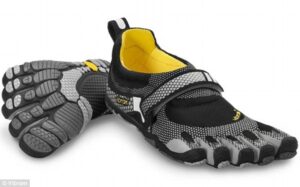
First of all, though, let’s be clear about what we mean by barefoot running. In its most literal sense barefoot running is, of course, running without shoes, but wider definitions also allow it to include running in minimalist or very thin-soled shoes. Many sports shoes companies have responded to the growth in interest in the subject by manufacturing specialist barefoot shoes. Nike, New Balance, Saucony and Vibram are among those to have developed minimalist shoes.
Supporters of the concept argue that barefoot running allows runners to adopt a more natural form and encourages a forefoot strike which gives greater protection from injuries than a heel-strike which is more common in runners who wear more conventional trainers.
One of the best argued cases for barefoot running, which I’ve read, is contained in Christopher McDougall’s excellent book ‘
Born to Run’ which explores the lives of the Tarahumara Indians in Mexico who, for generations, have been running exceptionally long distances with few injury problems and without wearing specialist training shoes. McDougall goes on to critically explore the relationship between running injuries and the sports shoe industry. He quotes Harvard University’s Dr. Daniel Lieberman, a professor of biological anthropology, who says: “A lot of foot and knee injuries that are currently plaguing us are caused by people running with shoes that actually make our feet weak, cause us to over-pronate, give us knee problems. Until 1972 when the modern athletic shoe was invented by Nike, people ran in very thin-soled shoes, had strong feet, and had much lower incidences of knee injuries.”
It’s a view supported by Brother Colm O’Connell, the Irish missionary who has been teaching and coaching at St Patrick’s High School in Iten since 1976 and is now popularly known as ‘the Godfather of Kenyan running.’ In his outstanding book,
‘Running with the Kenyans’, Adharanand Finn, quotes Brother Colm as saying: “We do all our exercises at the school in bare feet….In the West we put children in shoes before they can walk. What are we teaching them? We’re teaching them that the ground is dangerous, that they need to be protected from it. But Kenyan children can feel the ground, so they have a better relationship with it. They learn to place their foot carefully when they run, so they don’t hurt themselves. They learn to land gently, lightly, gliding over the earth rather than pounding it. Finn goes on to say: “Breaking world records and winning gold medals requires fine polishing of talent. ….running barefoot is one part of a formula that produces that talent, he (Brother Colm) says.”
There is, of course a long history of barefoot running. Roger Robinson, writing in
Running Times (April 2011), points out that the first recorded example of barefoot running in the Olympic Games was in 1904, when a Tswana tribesman, representing South Africa, finished ninth in the marathon. It first came to widespread attention, however, in 1960 when the world was astounded by Ethiopia’s Abebe Bikila, who set a world record time of 2hr 15min 16.2secs when winning the marathon at the Rome Olympic Games. He wasn’t considered to be one of the favourites, having only been added to his country’s team at the last minute following an injury to another athlete. But that wasn’t the main reason for the amazement expressed by commentators all over the globe. What really astounded them was that Bikila ran barefoot. It was the first, and so far only time a barefooted runner has won an Olympic marathon title. I have read varying accounts as to whether Bikila always trained barefooted or not but it would seem that if he did wear shoes, it wasn’t on a regular basis. He was apparently given training shoes for the Rome race but found they gave him blisters so he chose to dispose of them. The interesting point to note is that Bikila
chose to run barefoot, while most contemporary reports presumed he
had to because he didn’t have any other shoes. So, an opportunity to explore the issue was possibly missed. (Incidentally, Bikila went on to win the 1964 Olympic marathon in Tokyo, again in a record time of 2:12:11.2, just 40 days after having his appendix out. He wore shoes for that race).
And yet, at this same time, British athletes were also running barefoot. The best known was probably 1962 European 5,000m champion Bruce Tulloh. In an interview with
Athletics Weekly in June 2011, Tulloh said: “I won my first three As (Amateur Athletics Association) title in 1959 running barefoot. It's the lightest shoe there is and it's the most efficient. For the rest of my amateur career I ran in bare feet whenever possible, winning the European Championships 5000m, breaking the British record for two, three and six miles, winning the AAA three miles three times and the Inter-Counties title six times, twice finishing second in the National Cross-Country and placing seventh in the International Cross-Country.”
My own mentor, Scotland international Mel Edwards, who was one of Britain’s top marathon runners in the late 1960’s, was another who enjoyed barefoot running, but only on occasion. He said: “I used to train barefooted on the grass at Kings College in Aberdeen and raced barefoot over three miles. I found that wearing spikes was not as comfortable, although I wore them for distances under three miles to get more grip at the faster speed.” Mel also supports the comments made by Dr. Daniel Lieberman regarding thin-soled shoes. He added: “I wore Tiger (now Asics) Cubs for short road races and relays. They were made of canvas uppers and had a very thin sole. I wore Adidas Gazelles for longer races including marathons as they had much more cushioning.”
Like Edwards, Tulloh also admitted that barefoot running wasn’t always appropriate. He said: “It doesn’t work every time. I once had to drop out of the AAA three miles championships because we had a downpour just before the event started and I had not brought any spikes. When the surface is too hard you obviously need protection – when I ran 3000 miles across America, I ran in marathon shoes. When the surface is slippery you need spikes or studs to get a better grip.”
It is also noticeable that you will rarely, if at all, see any top class athletes running barefoot in major track, road or cross country races nowadays. So, it would appear, like many other things, there is a balance to be struck. There seems to be a place for totally barefoot running to be tried in appropriate circumstances. I have on occasion dabbled with a little barefoot running on the beach in summer or on a nice flat area of springy grass… and there’s no doubt it gets the foot working and I feel much better for it. There’s other occasions, running on roads, dirt trails etc, where I prefer the feel of a lightweight shoes which offers some protection from the hard surfaces and any dangerous items likely to pierce your skin, but are not as clumsy and heavy as to leave the feet feeling as though they are completely redundant.
Anyone wishing to experiment with barefoot running or wearing minimalist running shoes, should work into this by doing a little to begin with until adjusting to the different form and technique required. There is, I believe, a benefit on doing some barefoot running on a regular and progressive basis as it does appear to help strengthen the foot and ankles and it encourages an improvement in running form which in turns can help reduce the likelihood of injury.
Fraser Clyne is a former international marathon runner with a best time of 2 hours 11 minutes 50 seconds. Five times Scottish marathon champion, he competed in the 1986 Commonwealth Games marathon, finishing 10th.He has competed all over the world in 3K, 5K, 10K, half marathon and marathon races. He has run 22 sub-2 hour 20 minute marathons and is a sports journalist.