Speedplay – How to improve your marathon time by having fun
Fartlek has been around for more than 80 years and remains a popular and effective distance-running training method. Fraser Clyne explores its origins and benefits and suggests some interesting ways of applying it as part of your training programme.
Most of us are keen to improve our personal best times and to achieve that we need to include a reasonable element of fast running or speedwork in our training plans. But not everyone is too keen on regimented, timed interval or track sessions and if you don’t find these things fun then you are less likely to actually do them. In fact, you might not do them at all.
That’s where fartlek has its attractions. Even the name is psychologically more soothing and positive. Anything with the word ‘fart’ in it might attract a few sniggers, but it’s the Swedish term for ‘speed’ while the ‘lek’ part means play. While speedwork carries all the connotations of being something tough and possibly unpleasant, speedplay sounds altogether more like fun.
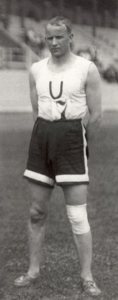
So what is it and how should you go about trying it? Swedish coach Gösta Holmér, left, is credited with being the first person to introduce fartlek, apparently in 1937, in an effort to improve the performances of his country’s athletes who were living in the shadows of the great Finnish distance runners of that era.
At its simplest, fartlek is about breaking your run into segments, some of which you run fast, others you run slow. It was once described to me as running at its most basic as it’s very much what you see young children doing when let loose in a park. It can be totally informal and done in so many different ways. It can be used in any environment but is particularly suited to undulating trail courses in beautiful settings. But you can do fartlek anywhere. That’s part of its attraction.
Holmér was an unlikely originator of this revolutionary new approach to training. He finished fourth in the decathlon at the 1912 Olympic Games in Stockholm but was awarded a bronze medal after the winner Jim Thorpe was disqualified for violating amateur rules. Thorpe was reinstated as a winner in 1982, and Holmér was moved down to fourth place again, yet he retained a bronze medal. He also finished eighth in the pentathlon. And at the 1920 Olympics in Antwerp, he was again fourth in the decathlon.
His background in multi-events competitions perhaps gave him a broader perspective on training methods and when he moved into coaching he came up with the idea of fartlek. It was ideal for the Swedish environment by making best use of the numerous forest trails and undulating landscape.
Swedish athletes Gunder Hägg and Arne Andersson were the first elite performers to demonstrate the benefits of fartlek as they dominated world middle distance running in the early 1940’s. In 1942, at the height of WW2, Hagg established ten world records over an 82-day period in seven different events, from 1500 metres to 5,000 metres. From 1942 to 1945 he swapped the world mile record five times with Andersson, taking it from 4:06.1 to 4:01.3, frustratingly close to the magical four-minute barrier which was finally cracked by Roger Bannister almost a decade later. Athletes following the fartlek principles would go on to set world records in a variety of distances from two miles to 10,000m at this time. Fartlek has been used to great effect by elite distance runners in every generation since then. But it’s not only the elites who have benefitted. Almost every club runner I’ve known has enjoyed and profited from fartlek.
Some of the original Swedish sessions might last for 12km with 5-6km being run at faster than race pace, but of varying lengths, the faster sections being anything from 40-50 metres up to 2.5km. The elite athletes would do this sort of session regularly, sometimes as often as three to five times a week. Fartlek wasn’t, however the only form of training they did. It would be supplemented by more formal repetition or interval training, tempo runs and even time trials. But there is no restriction on the overall distance.
So, what is the best way to do fartlek? There are so many variations that if you asked 100 coaches which sessions their athletes should do, you’d probably get 100 different suggestions. In many respects, that’s part of its appeal. It does offer variety and is open to innovative new ideas. The key is to get the pace correct. That’s all about not being too fast on the fast sections and not too slow on the slow recoveries. For marathon training you might want to do the shorter fartleks at your best mile pace, with mid-range fartleks at 5k-10km pace and your recovery jogs at half marathon or marathon pace. But there is no hard and fast rule. It’s all about play and discovery. Be innovative.
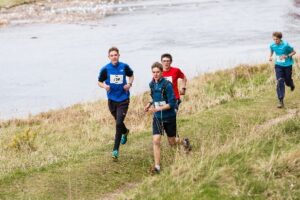
Depending on where you run, you might choose to run every uphill quickly then jog, or at least relax the pace, on the downhill or flat sections. Or you might sprint fast between lamp-posts, trees or any other features in the natural or man-made environment. The fast efforts can be over any distance and preferably should be attempted over a variety of distances within the one run. A fartlek session mixes speed and endurance over the course of a single session and helps utilise all your energy systems.
Another wonderful aspect of a fartlek session is that it can be done without looking at your watch. Just get out and get a feel for running fast for short and long bursts, with sufficient recovery jogs in between. The session should, however, preferably be completed without stopping.
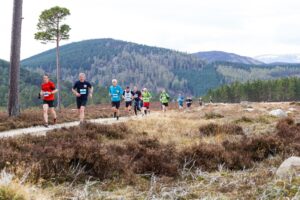
You can do fartlek on your own but an option is to do it as part of a group. This adds an element of mystery and intrigue to the session. You go out running with friends or clubmates and after a gentle warm-up the group fartlek begins. Each person in turn decides when to start the fast section of the run and how long it’s going to last. Everyone else in the group then has to try to keep up. So, runner number might decide to set off and run fast for 300 metres. No-one else knows, however, how long this fast part will last, but you all have to try to keep up. At the end of the 300 metres, the responsibility passes to runner number two who now decides, firstly, how long the recovery will be from runner number one’s effort and, secondly, how long the next fast effort will last. It could be 50 metres or 1500 metres. This continues until everyone in the group has had a chance of setting the pace and the length of the fast section. The session can end at that point or revert back to runner number one and the whole process repeats itself.
This can be done as a stand-alone session or it can be a stimulating way of spicing up the final 30-40 minutes of a long run. Let’s say you have been out for a two-hour group run which is done at a fine steady pace. To pep up the final 30-40 mins you can start a group fartlek session. It’s certainly a way of ensuring you stimulate your mental and physical effort at a point when you are getting tired: exactly what you have to do in a marathon.
Fraser Clyne is a former international marathon runner with a best time of 2 hours 11 minutes 50 seconds. Five times Scottish marathon champion, he competed in the 1986 Commonwealth Games marathon, finishing 10th. He has competed all over the world for Scotland and/or Great Britain in 3K, 5K, 10K, half marathon and marathon races. He has run 22 sub-2 hour 20 minute marathons and is now a sports journalist.